
Underneath the fairy tale is a map — one of several — psychologists have used for over 45 years.
Lovetopus looks like a bedtime story about a heart-headed octopus — and it is one. But every realm, every guardian, and every “silly” exercise in these books sits on a real frame: Robert Plutchik’s wheel of emotions, and the parenting practice researchers call emotion coaching. This page shows you the machinery. Not because a four-year-old needs to see it — because you deserve to know it’s there.
One thing before we start: Lovetopus is a storybook method, not a therapy. We’ll say exactly what that means — and where the line is — before this page ends.
Notice it. Name it. Understand it. Own it.
Every Lovetopus story runs the same quiet loop — the one emotion researchers keep arriving at from different directions, and the one a parent can actually do at bedtime, in pajamas, without a textbook. Here’s the loop, with a real four-year-old in it.
Step 1 — Notice the feeling
A feeling arrives in the body before it arrives in words.
The scene: Lights out. Your four-year-old’s heart is drumming, her tummy is tight, and the coat on the chair has grown teeth. She doesn’t say “I’m experiencing fear.” She says “I can’t sleep. Something is wrong with the dark.”
In the story, Finley the seahorse feels it exactly the same way — a small body noticing something big. The child watches a character notice a feeling from the inside, which is how children learn that the drumming heart is something, and that it has a beginning.
What the parent does: you notice out loud, calmly, without fixing anything yet. “I can see something feels really big right now.” That’s the whole move — you’re the mirror before you’re the guide.
Step 2 — Name it
A feeling with a name is smaller than a feeling without one.
The scene: You put a word between her and the dark: “That’s fear. Fear is your body’s guard — it wakes up to keep you safe, even when nothing is actually dangerous.” Watch her face: the thing in the room now has a shape, a size, and — in our books — an address. Fear lives in the Misty Narrows, and a small seahorse there is learning to swim through it.
What the parent does: you hand over the word. Not “don’t be scared” — the name. Giving feelings words is the working heart of the emotion-coaching approach researchers have studied for decades — the evidence lives one level down, on our science page.
Step 3 — Understand cause and effect
Where did it come from, what does it do, what happens next?
The scene: The next morning, over cereal, you walk the chain backwards together: “You heard the house creak → your guard woke up → the coat looked like a monster → we turned on the light and checked together → the monster was a coat.” In Book 1, Finley walks that same chain through the mist — and the shadow he’s been fleeing turns out smaller and friendlier than it looked. (No spoilers. It’s a good one.)
A three-to-six-year-old can’t yet run this chain alone — preschoolers genuinely struggle to separate imagined danger from real danger. That’s not a flaw; that’s the developmental stage. The story does the walking for them, safely, at one remove: it’s easier to understand Finley’s fear than your own.
What the parent does: you narrate the chain, in order, in small words — and you let the story carry the parts that are too close to home. “Have you ever felt like Finley?” is the whole technique.
Step 4 — Own it (this is what emotional intelligence is)
The loop, repeated, becomes a skill the child carries without you.
The scene: Three weeks later, at a sleepover — new house, new dark. And from the bunk bed, a small voice, unprompted: “My tummy is scared. I’m going to breathe like Finley.” Nobody coached that sentence. That’s the loop running on its own: noticed, named, understood — owned.
What the parent does: the hardest step — you get out of the way. And then you make an enormous, delighted fuss at breakfast.
Emotional intelligence isn’t only a talent some children are born with. It’s this loop — notice, name, understand, own — run enough times, with someone who loves you, until it’s yours.
Eight feelings. One map. We didn’t invent it — we illustrated it.
In 1980, psychologist Robert Plutchik organized human emotion into a model that looks, on paper, like an eight-petalled flower: eight core emotions — joy, trust, fear, surprise, sadness, disgust, anger, anticipation — each with its own intensity scale (apprehension → fear → terror), each sitting opposite its natural counterweight (fear across from anger, joy across from sadness).
Psychologists have used, taught, and argued with that wheel for over 45 years. And we’ll be honest about the “argued with”: Plutchik’s model is one influential map among several — scientists still debate how many “basic” emotions there are, and no single model owns the field. We chose the wheel not because it ended that debate, but because it’s the model built for teaching: a small, countable set of feelings, a visible intensity dial, and a shape a child can hold.
Lay Plutchik’s flower over the map of EmOcean and the fairy tale clicks into place: eight petals, eight realms, eight guardians. Fear’s petal is the Misty Narrows, where Finley lives. Anger’s petal is the Ember Sands. The intensity scale — apprehension, fear, terror — is why the Narrows have shallows and depths. The wheel isn’t a poster on our wall; it’s the load-bearing structure of the world your child falls in love with. When she learns her way around EmOcean, she is — without ever seeing a diagram — learning her way around the wheel.
The full model — intensity zones, opposites, the blends Plutchik called dyads, and why we trust it — is on the science page →
One book, three layers — because three different people open it.
A Lovetopus book is built like the bedtime it’s for: the child gets a story, the child-and-parent get something to do together, and the parent gets the grown-up words — in that order, in one object.
Layer 1 — The Story (for the child)
Around forty big-illustrated pages, and always the same deep pattern: a feeling arrives → it becomes a crisis → the hero understands it → the hero is transformed by it. In Book 1, Finley the seahorse meets the shadow in the Misty Narrows. The pattern matters more than any single plot: the child watches a character their own emotional size move through the whole loop from above — noticing, naming, understanding, owning — dressed as an adventure. Identification does the teaching: it’s easier to understand Finley’s fear than your own.
Layer 2 — The Kids Zone (for the child and parent together)
After the story, Hugo — the heart-headed octopus who guides the series — explains the feeling in child words: what fear is for (“your body’s guard”), why it shows up, why it’s not the boss. Then the book turns into play: activities that rehearse the story’s skill with the book open on your laps — breathing like Finley, drawing the fear to give it a funny shape, crafting a courage keepsake from the story. This is the layer where the reading becomes back-and-forth — where you pause, point, ask, and listen. It’s deliberately the heart of the book.
Layer 3 — The Parent Zone (for you, after lights out)
The last pages drop the fairy tale and talk to you straight: why this feeling happens (what it’s for, developmentally), what your child might be feeling (from the inside, in their words), and how to talk about it — acknowledge and validate first, give the feeling its name, use the story as a shared reference point, and share your own version (“I get scared sometimes too”). Psychoeducation, not homework: a few pages you can read in ten minutes that change how tomorrow’s hard moment goes.
🌊 Seahorse Breathing
The exercise every Lovetopus child learns first — in the book, from Finley.
Smell the flower — a slow breath in through the nose, for about three counts.
Blow out the candle — a long breath out through the mouth, for about four counts.
That’s the whole exercise. The longer, slower breath out is what settles a revved-up little body — and the flower and candle give a preschooler something concrete to do with an instruction as abstract as “calm down.” Practise it in calm moments first (it’s a lovely game); then it’s there, already familiar, on the night it’s needed. One exercise, one rhythm, everywhere — in the books, on this site, in everything we make — so your child meets the same tool every time.
What we are — and what we’re not.
Lovetopus is evidence-informed, not a treatment. Our books stand on published research — Plutchik’s model, decades of emotion-coaching studies, the shared-reading literature (all of it cited, link by link, on the science page) — and they are still storybooks: tools that help parents practise naming and talking about feelings. They don’t diagnose anything, they don’t treat anything, and we will never write a sentence that pretends otherwise.
And one thing we want said plainly: big feelings at three-to-six are overwhelmingly normal — fear of the dark, meltdowns, drop-off tears are development, not disorder. But if a feeling is intense, persistent, and getting in the way of your child’s ordinary life — sleep, preschool, play, family — for weeks, or follows a frightening event, that’s the moment for a professional: start with your pediatrician, or a child mental-health specialist. A book is a wonderful companion. It is not a substitute for one — and knowing the difference is part of the method.
Which big feeling is at your house tonight?
Every Lovetopus book and article starts from a real, googled-at-10pm problem. We keep a working catalog of 51 of them, mapped to the eight feelings. Here’s a taste — one from six of the eight:
- Fear Book 1 covers it → Afraid of the dark — bedtime becomes a battle. Finley and the Shadow of Fear.
- Anger Next on the map → Tantrums and meltdowns — explodes, then feels bad. Be first when it charts.
- Sadness In the catalog — article first → Big tears over “small” things (the knocked-over tower).
- Joy In the catalog — book candidate → Won’t share / turn-taking battles.
- Trust Next on the map → “You promised!” — devastated by a broken promise. Be first when it charts.
- Disgust In the catalog — book candidate → “Yuck!” — picky eating peaks.
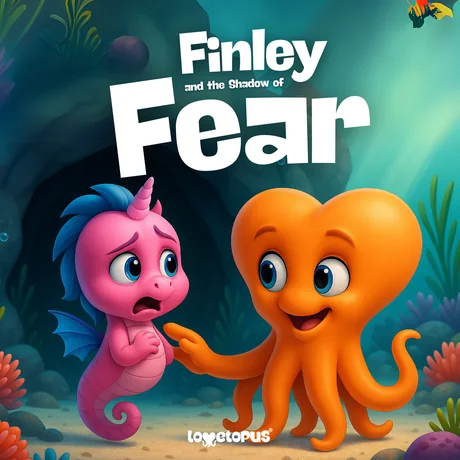
And if tonight’s problem is the dark —
Get Book 1 on AmazonFinley and the Shadow of Fear — the first charted realm.