
The science we stand on — link by link.
This page exists for the reader who doesn’t take “backed by science” as a decoration. Below is the actual frame under the Lovetopus method: the emotion model we borrowed, the parenting research we built for, and the reading research that shaped the books — every study named, dated, and linked to its DOI. Just as important, at the end you’ll find the section most children’s brands don’t publish: what this evidence does not prove, and what we therefore don’t claim.
In one paragraph: emotional skills are teachable, and teaching them in early childhood works — that part is meta-analytically established. Parents coached to notice, name, and guide their children’s emotions measurably improve those children’s emotional competence — that’s randomized-trial evidence. Shared book reading is a proven engine for language, and how you read (back-and-forth, not read-at) matters — with a growing, review-level case for shared books as a natural vehicle for emotional skills. Lovetopus books are built to make that practice — evidence-based emotion coaching — easy to do at bedtime. The evidence is for the practice; the books are the instrument. That’s the claim, whole.
Why we built a world on an eight-petalled flower.
2.1 — What the wheel is.
Robert Plutchik (1927–2006) proposed his psychoevolutionary theory of emotion across two decades of work, giving it its canonical form in Emotion: A Psychoevolutionary Synthesis (1980). Its famous visualization — the wheel, classically drawn as an eight-petalled flower — organizes emotion in three moves:
- Eight primary emotions: joy, trust, fear, surprise, sadness, disgust, anger, anticipation. Plutchik argued these are evolution’s basic repertoire — each one an ancient, adaptive response (fear prepares escape; anger prepares defense; trust enables bonding).
- Intensity gradients. Each primary emotion is a dial, not a switch: apprehension → fear → terror; serenity → joy → ecstasy; annoyance → anger → rage. The same feeling, at three volumes — which is exactly how a parent experiences a child’s day.
- Opposites and blends. Each emotion sits across the wheel from its counterweight — joy ↔ sadness, trust ↔ disgust, fear ↔ anger, surprise ↔ anticipation — and adjacent emotions blend into the feelings Plutchik called dyads: joy + trust = love; fear + surprise = awe; anticipation + joy = optimism.
2.2 — Why we chose it (four working reasons).
- It’s countable. Eight is a set a four-year-old can hold — and a world-builder can build on. Dozens-of-feelings taxonomies are true and unteachable at three.
- It has a volume dial. The intensity gradient gives families the single most useful sentence in emotion talk: “Is it apprehension-sized or terror-sized?” Feelings stop being on/off.
- It has geometry. Opposites and blends mean the model isn’t a list — it’s a map with directions in it. Maps can become worlds. (Ours did: eight petals, eight realms, eight guardians. The wheel is EmOcean’s skeleton.)
- It’s pedagogically proven ground. The wheel has been a workhorse of emotional-vocabulary teaching in classrooms and counseling for decades — it was built to be taught, not just defended.
2.3 — The honest framing.
Psychologists have used, taught, and argued with Plutchik’s wheel for over 45 years — and “argued with” is part of the sentence on purpose. Basic-emotion theories (Plutchik’s among them) are one family of models in an unfinished scientific debate; other researchers model emotion as dimensions (how pleasant, how intense) or as constructions built in the moment. No one model owns the field, and we won’t pretend ours does. We use the wheel the way you’d use any good map: as an organizing tool for teaching vocabulary and structure — not as a verdict on how emotion “really” works, and never as a diagnostic instrument. The model is credited to Robert Plutchik everywhere it appears in our work; in the books it wears an in-world costume (a living, glowing eight-petalled plant a child can meet inside the story — same structure, no labels), and on this layer of the site it appears as itself, labels on.
2.4 — A note on the second wheel you may have seen.
Parents sometimes know the “feelings wheel” — the sunburst chart with dozens of specific feeling words (lonely, guilty, hurt…) radiating from a few cores, in the tradition of Gloria Willcox’s Feeling Wheel (1982). That’s a different instrument: a vocabulary-expansion tool, without Plutchik’s intensity/opposites geometry. Useful — we may borrow its spirit in parent materials — but it isn’t the model the world is built on, and we keep the two cleanly apart.
What’s established, what’s promising, what’s honestly still a rationale.
Below, each strand is labeled by its strength: established (meta-analyses and randomized trials), supporting (single studies, cohorts), or rationale (a plausible, cited chain that no single trial has tested end-to-end). Watch how the labels are used — that’s the difference between this page and a marketing page.
Strand 1 — Emotional skills are teachable, early. (established)
The foundational fact under everything we make: social-emotional skills respond to teaching, and responding starts young. A meta-analysis of 79 studies covering roughly 18,000 children aged ~2–6 found that universal, curriculum-based social-emotional learning in early-childhood settings improves children’s social competence and emotional regulation (Blewitt et al., 2018, JAMA Network Open). The pattern holds at scale in the landmark K–12 meta-analysis of school-based SEL programs (Durlak et al., 2011, Child Development). Attribution note (binding): the 79-studies / 18,000-children / ages ~2–6 figures belong to Blewitt ONLY; Durlak is cited as the K–12 landmark, no figures attached.
Strand 2 — Emotion coaching: the parenting practice with a trial record. (established)
In 1996, John Gottman and colleagues named the parental stance behind it — meta-emotion philosophy — and described the coaching parents (Gottman, Katz & Hooven, 1996, Journal of Family Psychology), popularized as “emotion coaching” in his 1997 book — treating a child’s feelings as moments for connection and teaching (notice the feeling, name it, set limits on behavior but not on the feeling). What began as observation became intervention: the Tuning in to Kids program taught the practice to parents of preschoolers and tested it in randomized controlled trials — improving parents’ emotion socialization and children’s emotional competence in a community RCT (Havighurst et al., 2010, Journal of Child Psychology and Psychiatry), and reducing young children’s behavior problems (Havighurst et al., 2013, Child Psychiatry & Human Development). The finding travels: an RCT replicated the program’s effects with families in Hong Kong (Chan, Qiu & Shum, 2021, Developmental Psychology), and an RCT of the program delivered fully online found it works in that format too (Burkhardt, Röösli & Müller, 2024, Scientific Reports). Zooming out, a meta-analysis of randomized trials of emotion-socialization parenting interventions confirms the pattern across programs (England-Mason et al., 2023, Clinical Psychology Review).
Why this strand matters most to us: emotion coaching is a parent practice — it’s teachable, trial-tested, and it happens in ordinary moments. Lovetopus books are built to make evidence-based emotion coaching easy to do at bedtime: the story supplies the feeling at a safe remove, the Kids Zone supplies the pause-and-talk structure, the Parent Zone supplies the grown-up words. The trials above tested coaching programs, not our books — the books are our way of putting that practice in your hands.
Strand 3 — Naming a feeling calms the brain — shown in adults. (supporting, with a bridge)
Putting feelings into words does something measurable: in fMRI studies with adults, labeling an emotion dampened amygdala response — the brain’s alarm — while engaging prefrontal regions (Lieberman et al., 2007, Psychological Science); a decade of follow-up work positions “affect labeling” as a form of implicit emotion regulation (Torre & Lieberman, 2018, Emotion Review). The qualifier is the claim: this neuroscience is adult neuroscience. The bridge to children runs through Strand 2 — naming feelings is precisely the skill the emotion-coaching trials taught parents to practise with children, with measured benefit. We cite the adult mechanism as why the practice is plausible, and the child RCTs as whether the practice works. Two different questions, two different literatures — we keep them apart on purpose.
Strand 4 — Shared reading: the vehicle. (established for language; rationale for SEL — a chain, never one claim)
Here is the strand we’re most often tempted to overstate, so watch us not do it. Four separate findings, presented as the chain they are:
- Shared reading builds language — meta-analytically established for shared picture-book reading interventions (Dowdall et al., 2020, Child Development).
- How you read matters — dialogic, back-and-forth reading (ask, pause, follow the child) beats read-at reading, again meta-analytically (Mol et al., 2008, Early Education and Development).
- Shared reading is a plausible vehicle for emotional skills — the closest published statement of the Lovetopus rationale is a narrative review of shared reading as a context for social-emotional learning (Schapira & Grazzani, 2025, Frontiers in Psychology). A review, not a meta-analysis — we cite it at review-level confidence, no higher.
- The missing link, stated plainly: no randomized trial has yet tested shared book reading with an SEL outcome as its primary endpoint. That trial doesn’t exist, so we don’t cite it — and any children’s brand that implies it does is selling past the evidence.
What the chain licenses us to say: a picture book read together — pausing to name the feeling on the page, asking “have you ever felt like Finley?” — is dialogic reading, feeling-naming, and emotion coaching folded into one bedtime. The benefit lives in that practice; the book is built to scaffold it. A design rationale, honestly labeled — not an outcome proof.
Strand 5 — Why we’re book-first: the shared-attention evidence. (supporting — associations, not verdicts)
Lovetopus’s book-first stance is a belief and a design choice (the full argument lives on The Idea); here is the evidence that informs it, at exactly its own strength. On the parent’s side: a 2025 meta-analysis found parental technology use in a child’s presence (“technoference”) associated with poorer cognitive and socioemotional outcomes in early childhood (Toledo-Vargas et al., 2025, JAMA Pediatrics). On the child’s side — a separate question, studied separately: in a longitudinal cohort, more screen time at ages 2–3 predicted poorer performance on developmental screening at ages 3–5 (Madigan et al., 2019, JAMA Pediatrics). And one small, hopeful experiment: preteens who spent five screen-free days at camp improved at reading nonverbal emotion cues versus controls — one study, older kids, short-term (Uhls et al., 2014, Computers in Human Behavior). These are associations and single findings, not verdicts on screens — we don’t claim screens are proven to harm, and we make no claims about other products. We simply chose to build for the face-to-face moment the evidence keeps pointing back to.
Read this section the way you’d read our best one.
- We don’t claim children’s emotional skills are “declining.” No study establishes a secular decline in children’s emotion-recognition or expression skills — the literature is silent, so we are too. What we say instead: these skills are built through face-to-face practice, and a busy, screen-lit day can crowd those moments out — a mechanism and a risk, not a diagnosis of a generation.
- We don’t claim the Plutchik wheel is a diagnostic or complete model of emotion. It’s one influential map among several in an unfinished scientific debate — we use it as a teaching tool for vocabulary and structure, never to assess, diagnose, or categorize a real child, and never as the last word on how emotion “really” works.
- We don’t claim reading Lovetopus books is proven to build emotional intelligence. The evidence chain in Strand 4 is a rationale; the trial at its end hasn’t been run. Our books are built to make a well-evidenced parent practice easy — that’s the claim, and the whole claim.
- We don’t claim the affect-labeling neuroscience is child evidence. It’s adult fMRI work, bridged to children through the coaching RCTs — and we label it that way every time.
- We don’t claim screens damage children. The screen-related findings we cite are associations and single experiments; our book-first stance is a design choice those findings inform, not a clinical verdict they prove.
- We are not a treatment, and our books are not therapy. Nothing here diagnoses, treats, or substitutes for professional care. Big feelings at 3–6 are overwhelmingly normal development. If a feeling is intense, persistent, and interfering with your child’s ordinary life for weeks — or follows a frightening event — talk to your pediatrician or a child mental-health professional. For a parent-friendly starting point on childhood anxiety, the American Academy of Child & Adolescent Psychiatry’s family guide is excellent (AACAP, Facts for Families #47: The Anxious Child).
We’d rather show you the links than pretend they’re welded. If our evidence page ever reads like our ad copy, hold us to this section.
Every source on this page, in one list.
The model
- Plutchik, R. (1980). Emotion: A Psychoevolutionary Synthesis. New York: Harper & Row. (book — no DOI)
- Willcox, G. (1982). The Feeling Wheel. Transactional Analysis Journal, 12(4). (context only — the “second wheel” note, §2.4)
SEL is teachable, early
- Blewitt, C., et al. (2018). Universal curriculum-based social and emotional learning in early-childhood education & care: systematic review & meta-analysis. JAMA Network Open, 1(8). https://doi.org/10.1001/jamanetworkopen.2018.5727
- Durlak, J. A., Weissberg, R. P., Dymnicki, A. B., Taylor, R. D., & Schellinger, K. B. (2011). The impact of enhancing students’ social and emotional learning: a meta-analysis of school-based universal interventions. Child Development, 82(1), 405–432. https://doi.org/10.1111/j.1467-8624.2010.01564.x
Emotion coaching
- Gottman, J. M., Katz, L. F., & Hooven, C. (1996). Parental meta-emotion philosophy and the emotional life of families: theoretical models and preliminary data. Journal of Family Psychology, 10(3), 243–268. https://doi.org/10.1037/0893-3200.10.3.243
- Havighurst, S. S., Wilson, K. R., Harley, A. E., Prior, M. R., & Kehoe, C. (2010). Tuning in to Kids: improving emotion socialization practices in parents of preschool children — findings from a community trial. Journal of Child Psychology and Psychiatry, 51(12), 1342–1350. https://doi.org/10.1111/j.1469-7610.2010.02303.x
- Havighurst, S. S., et al. (2013). “Tuning into Kids”: reducing young children’s behavior problems using an emotion-coaching parenting program. Child Psychiatry & Human Development, 44. https://doi.org/10.1007/s10578-012-0322-1
- Chan, R. F., Qiu, C., & Shum, K. K. (2021). Effectiveness of the Tuning in to Kids parenting program for Chinese parents in Hong Kong: a randomized controlled trial. Developmental Psychology, 57. https://doi.org/10.1037/dev0001258
- Burkhardt, S. C. A., Röösli, P., & Müller, X. (2024). Tuning in to Kids delivered online improves emotion socialization and child behavior — first RCT. Scientific Reports, 14. https://doi.org/10.1038/s41598-024-55689-z
- England-Mason, G., et al. (2023). Emotion socialization parenting interventions targeting emotional competence in young children: systematic review & meta-analysis of RCTs. Clinical Psychology Review. https://doi.org/10.1016/j.cpr.2023.102252
Affect labeling (adult evidence)
- Lieberman, M. D., Eisenberger, N. I., Crockett, M. J., Tom, S. M., Pfeifer, J. H., & Way, B. M. (2007). Putting feelings into words: affect labeling disrupts amygdala activity in response to affective stimuli. Psychological Science, 18(5), 421–428. https://doi.org/10.1111/j.1467-9280.2007.01916.x
- Torre, J. B., & Lieberman, M. D. (2018). Putting feelings into words: affect labeling as implicit emotion regulation. Emotion Review, 10(2), 116–124. https://doi.org/10.1177/1754073917742706
Shared reading
- Dowdall, N., et al. (2020). Shared picture-book reading interventions for child language development: a systematic review and meta-analysis. Child Development, 91(2). https://doi.org/10.1111/cdev.13225
- Mol, S. E., Bus, A. G., de Jong, M. T., & Smeets, D. J. H. (2008). Added value of dialogic parent–child book readings: a meta-analysis. Early Education and Development, 19(1), 7–26. https://doi.org/10.1080/10409280701838603
- Schapira, R., & Grazzani, I. (2025). Shared book reading and social-emotional competences in educational settings: a narrative review. Frontiers in Psychology, 16. https://doi.org/10.3389/fpsyg.2025.1622536
Shared attention & screens (associations)
- Toledo-Vargas, M., et al. (2025). Parental Technology Use in a Child’s Presence and Health and Development in the Early Years. JAMA Pediatrics. https://doi.org/10.1001/jamapediatrics.2025.0682
- Madigan, S., Browne, D., Racine, N., Mori, C., & Tough, S. (2019). Association between screen time and children’s performance on a developmental screening test. JAMA Pediatrics, 173(3), 244–250. https://doi.org/10.1001/jamapediatrics.2018.5056
- Uhls, Y. T., et al. (2014). Five days at outdoor education camp without screens improves preteen skills with nonverbal emotion cues. Computers in Human Behavior, 39, 387–392. https://doi.org/10.1016/j.chb.2014.05.036
When to seek help (family guidance)
- American Academy of Child & Adolescent Psychiatry. Facts for Families #47: The Anxious Child. aacap.org
The story is the delivery system. This page is what it delivers.
That’s the frame — the model, the trials, the chain, and the gaps. If it reads like a lot of machinery for a bedtime story: yes. That’s the point.
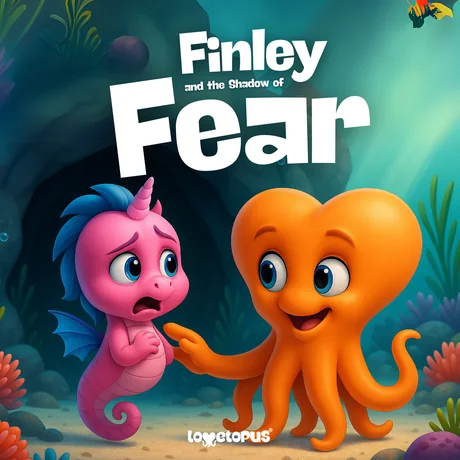
When you’re ready to meet the fear realm first —
Get Book 1 on AmazonFinley and the Shadow of Fear — the first charted realm.