

Lovetopus helps parents raise children who understand their own feelings — one storybook at a time.
- Mission
- To give parents simple, beautiful tools for real time together: books to read side by side that teach the language of feelings — and leave memories behind.
- Vision
- A generation of children with words for what they feel, and families grown closer by teaching them.

Nobody is born knowing what a feeling is called.
Every child has to learn fear, anger, joy, and sadness the way they learn words: from the face and the voice of someone who loves them. Big feelings are hard for every child — that isn't a flaw, it's the curriculum. But in today's fast, digital world, the moments where those lessons happen — a feeling caught, named, and handed back — are easy for any family's day to crowd out. Not because children changed, and not because parents stopped caring. Because a modern day is very good at filling itself.
- The learning matters early: clinicians describe emotional struggles such as anxiety presenting in children as young as preschool (Franz et al., 2013, JAACAP; Whalen et al., 2017) — which is exactly when these skills are so teachable.
- And it matters for the world our kids grow into: a 37-country study found school loneliness among teenagers (15–16-year-olds) rising worldwide after 2012 (Twenge, Haidt et al., 2021, Journal of Adolescence). The protective skills for that world are laid down years earlier — in exactly the moments this page is about.

Big feelings are learned in shared moments — not downloaded.
The science of early childhood calls it serve and return: a child sends up a feeling, an adult catches it, names it, and sends it back smaller (Harvard Center on the Developing Child). That exchange is where the words for feelings are handed over. It needs two faces, in the same room, with nowhere else to be.
And that exchange is exactly what a screen-lit day can quietly crowd out — from either side of the lap. When it's the grown-up's phone: a 2025 meta-analysis in JAMA Pediatrics found a parent's technology use in a young child's presence associated with weaker attachment, fewer prosocial moments, more behavior struggles (Toledo-Vargas et al., 2025). When it's the child's screen — a separate question, studied separately — more screen time at two and three predicted poorer developmental screening, communication included, at three and five (Madigan et al., 2019, JAMA Pediatrics). Associations, not verdicts. And one hopeful flip side: give a group of preteens five screen-free days at summer camp, and their reading of emotional cues measurably improved (Uhls et al., 2014). One study, older kids — and still the point: these are practice skills. They answer to practice.
These skills aren't disappearing — they're built. And the moments that build them are exactly the ones a busy day can crowd out, and a bedtime can win back.
Five things we believe — and build by.
-
Lovetopus is book-first by design. A real book, on a real lap, at a real bedtime. Everything else we ever make exists in service of that moment — never as a replacement for it.
-
Digital is not excluded — but it is not the point. We are not here to pull your child into more tablet entertainment. This is a choice about what we build, not a verdict on what anyone else builds.
-
In quality time spent together: reading, discovering worlds and characters, talking through the problems the heroes live through. It builds something no download ships with — memories.
-
With every book, we are building an optional online extension for parents — the theory, the scripts, the practice behind the exact feeling your child is taming. Here is how it will work: each book will unlock its own parent area, it will always be optional, and it will never be a gate your family has to clear to "finish" a book — and never a destination for your child's screen time. We'll tell you the moment it's live.
-
Quality time. A stronger bond. Shared memories. A child with words for what's happening inside. Those are our metrics — not screen time, not session length, not "daily active users." Any digital thing we ever build gets judged against that bar, or it doesn't ship.

Every big feeling is a place.

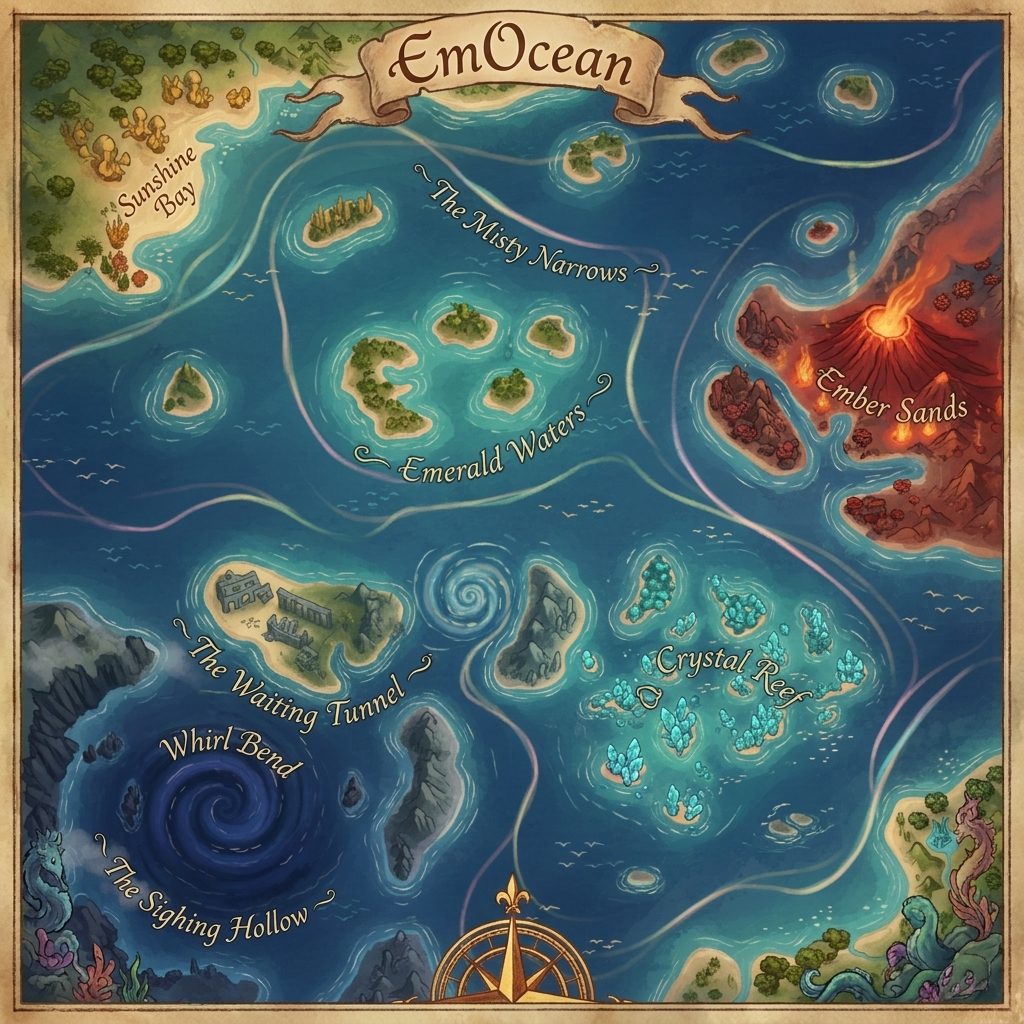
EmOcean is the map of your child's emotions. Hugo the Lovetopus is your compass — for the waters they can't yet name.
Inside every child there's an ocean, and each big feeling has its own realm there: fear lives in the Misty Narrows, where a small seahorse named Finley is learning to swim through it. One book at a time, we chart that water. And the compass is in your hand — this map is a tool for the parent, never a device for the child — because science keeps arriving at the same quiet conclusion: the grown-up who names the water is how a child learns to swim it.
Why a book, read together? The rationale, link by link — we say the chain, we don't collapse it:
- Emotional skills are teachable, and teaching them early works — that part is proven (Blewitt et al., 2018, JAMA Network Open — 79 studies, 18,000 children aged ~2–6; the pattern holds in the K–12 landmark, Durlak et al., 2011).
- Parents coached to name and guide emotions measurably improve young children's emotional competence — randomized trials, meta-analyzed (England-Mason et al., 2023; Havighurst et al., 2010).
- Naming a feeling calms the brain's alarm response — shown in adults (Lieberman et al., 2007; Torre & Lieberman, 2018) — and naming feelings is exactly what those coaching programs teach parents to do with children.
- And reading together is fertile ground for all of it: shared reading is proven to build language, and how you read matters — back-and-forth beats read-at (Dowdall et al., 2020; Mol et al., 2008) — with a growing case for shared books as a natural vehicle for emotional skills (Schapira & Grazzani, 2025).
Put those links together and you'll see what a picture book, read with a child — pausing to name the feeling on the page, to say it's okay, to ask "have you ever felt like Finley?" — actually is: dialogic reading, feeling-naming, and emotion coaching, folded into one bedtime. The benefit lives in that practice. Our books are built to make that practice easy — to make evidence-based emotion coaching something you can do at bedtime, in pajamas, without a textbook.
That's a chain of evidence and a design rationale — not one magic study, and not a promise. We'd rather show you the links than pretend they're welded. The full, verified bibliography lives in The Method.
Come see what Lovetopus is building.
If any of this sounds like your kitchen at 7pm — the big feeling, the small person, the words that won't come — you're exactly who Lovetopus is for. Start where every family starts: inside the world our books are made of.
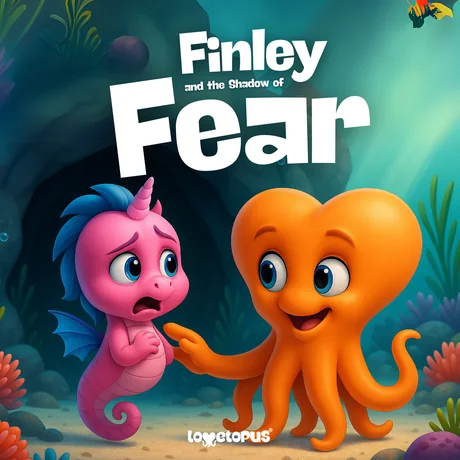
And when you're ready to meet the fear realm first —
Get Book 1 on AmazonFinley and the Shadow of Fear — the first charted realm.