
Hugo Lovetopus — the little psychologist of EmOcean.
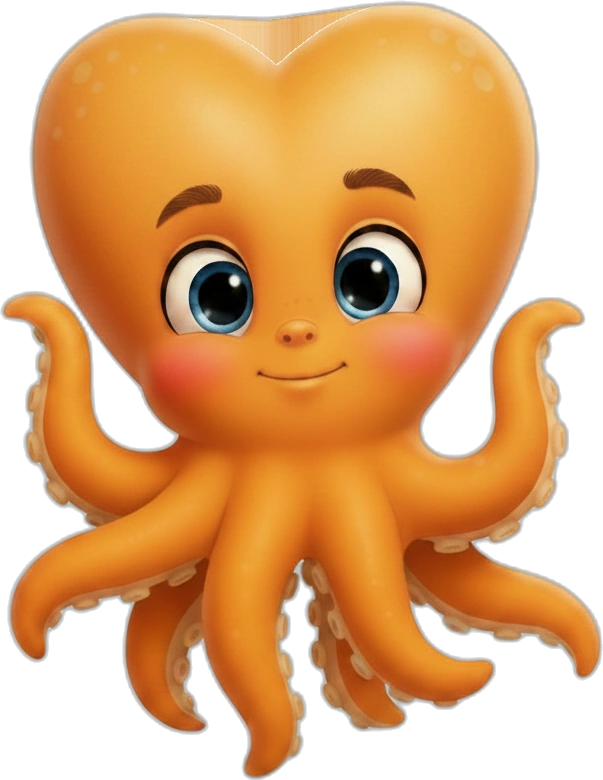
An octopus with a heart-shaped head (slightly lopsided — he jokes about it when he's embarrassed), soft pastel orange-pink. Hugo is the only one in EmOcean with no realm of his own. He travels all of them, reading the Feelstream — the glowing current that carries every feeling in the sea — and when a big feeling gets too big somewhere, he's already on his way, calling his favorite word: "Lovalicious!"
He never fixes a feeling. He sits down next to it.
In every Lovetopus story, Hugo does the same quiet thing: he finds the friend who's struggling, and instead of shooing the feeling away, he helps them name it. A named feeling is a smaller feeling — that's the oldest trick in EmOcean, and it's the heart of the method underneath these books. When Finley's fear fills a whole cave, Hugo doesn't say "there's nothing to be afraid of." He says, in effect: let's look at it together.
Hugo is how the method moves through this world — in every book he sits down next to a feeling instead of shooing it away, then hands you, the grown-up, the words for it.
EmOcean is the map of your child's emotions. Hugo is your compass.
The realms belong to your child — the fog, the feelings, the slow charting of both. Hugo belongs to you: the steady point that helps a parent navigate waters their child can't yet name. Every book puts him in your hands — the story for them, the words for you.
Wherever the story goes, Hugo goes.
Hugo appears in every Lovetopus book — Book 1 today, every realm eventually — always as the guide, never the hero. The brave steps belong to the guardians; the naming belongs to Hugo. Even a guide has feelings, though: when too many strong ones surround him at once, his eight gentle arms — each able to glow the color of a feeling — flicker together, and he needs a quiet moment and a nibble of Emogoo, his jelly emotion-snack. In EmOcean, even the guide gets to be a work in progress.